Sediment Filters for Well Water: Choosing and Maintaining One

October 25, 2026 | Water Quality

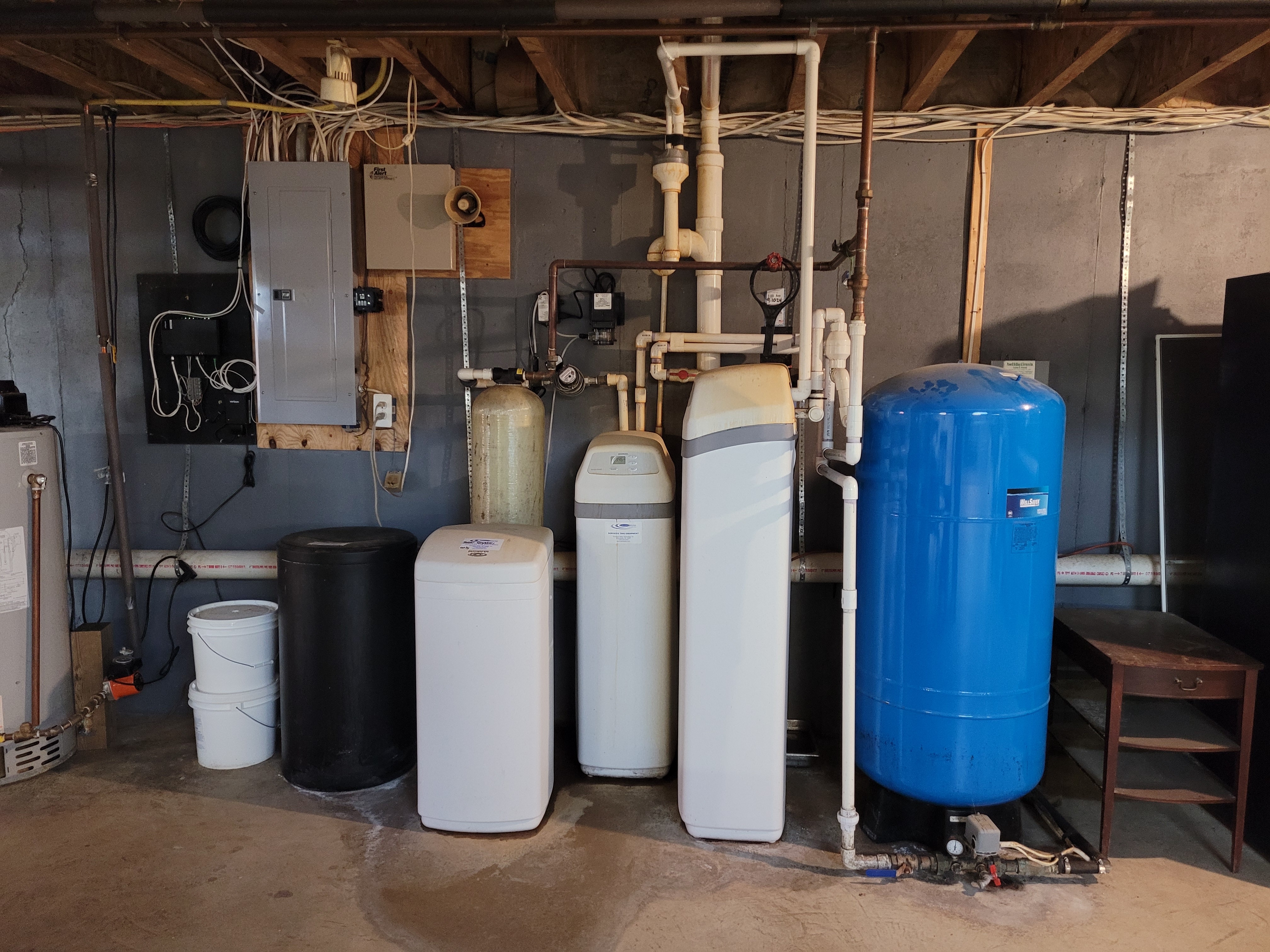
Every well carries some sediment: fine sand, silt, and clay from the ground around it. The amount depends on the local soil and rock, and it usually increases when the water level in the well drops during heavy use. A sediment filter is the simplest and least expensive piece of well water treatment, and for many homes it’s the first one worth installing.What a sediment filter does, and doesn’t doA sediment filter catches particles: sand, grit, silt, and rust flakes. That protects faucets, valves, appliances, and any treatment equipment downstream. It also makes cloudy water clearer when sediment is the cause.A sediment filter does not remove dissolved substances. It won’t fix acidic water, remove dissolved iron or manganese, soften hard water, or remove nitrate. It also doesn’t disinfect: a filter can trap some bacteria, but it is not a treatment for a positive coliform result. If your water test shows … Continued
Read More

Hard Water and Dissolved Minerals: Hardness, TDS, Conductivity, and Chloride

October 21, 2026 | Environmental Services

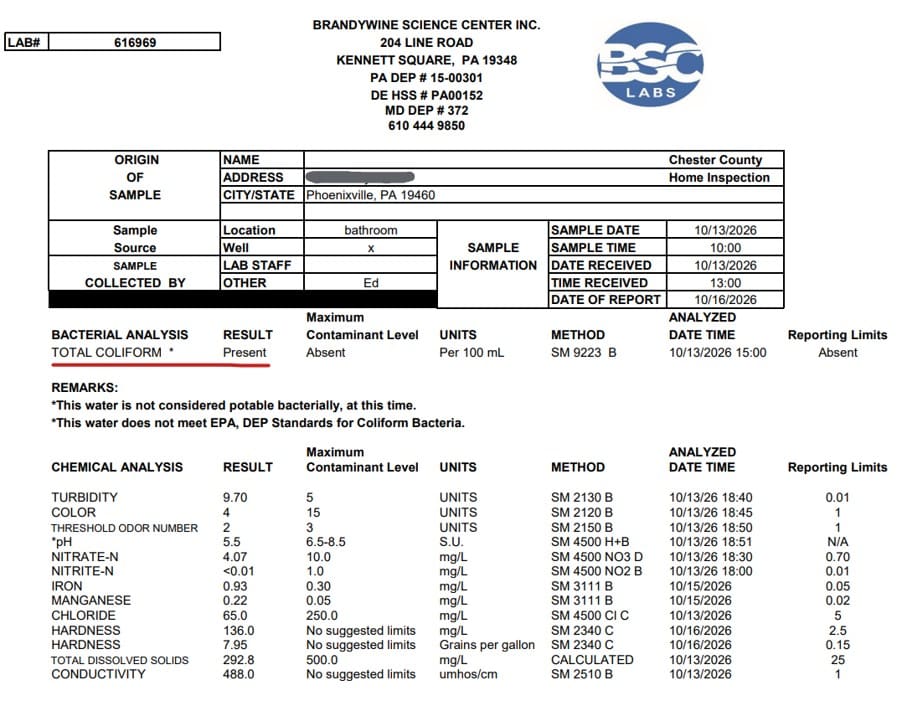
Four results on your water report all describe the minerals and salts dissolved in your water: hardness, total dissolved solids (TDS), conductivity, and chloride. None of them is a health concern at the levels typically found in well water. They mostly affect scale buildup, taste, and plumbing, and hard water also changes how soap behaves: minerals keep soap from lathering well and leave a film behind. Here’s what each one tells you, and when it’s worth doing something about.HardnessHardness measures dissolved calcium and magnesium, picked up as groundwater moves through rock. These minerals are harmless, and are in fact nutrients we need. The trouble comes when water is heated or evaporates: hard water leaves white scale on fixtures, shortens the life of water heaters, and keeps soap from lathering well.Your report gives hardness two ways: in milligrams per liter (mg/L) and in grains per gallon (gpg). One grain per gallon equals about … Continued

Read More

Nitrate and Nitrite in Well Water: Why Infants Matter Most

October 21, 2026 | Chester County

Most of the chemical results on a well water report are about taste, staining, or plumbing. Nitrate and nitrite are different: they have health-based limits, set to protect infants. Nitrate is also a particular concern in southeastern Pennsylvania, where farming and development are common. Here’s how to read your results and when to act.Reading the numbersYour report lists Nitrate-N and Nitrite-N. The “-N” means the result is reported as the amount of nitrogen, which is the standard way labs report it.Nitrate-N: limit of 10 mg/L. This is the same as 45 mg/L of nitrate, so don’t be confused if you see that number elsewhere. A result climbing toward 10 is worth watching, and anything above 10 calls for action.Nitrite-N: limit of 1.0 mg/L. Nitrite is usually below the detection limit in well water. A measurable result is unusual and worth retesting, since it can point to a nearby source of … Continued

Read More

Acidic Well Water: What Your pH Result Means

October 21, 2026 | Berks County

Acidic water is one of the most common findings in well tests across our area. Penn State Extension estimates that about 60% of private wells, springs, and cisterns in Pennsylvania have corrosive water, and the shale bedrock found in parts of southeastern Pennsylvania is known for it. Low pH isn’t harmful to drink by itself, but it quietly eats away at your plumbing and can put copper and lead into your drinking water.What pH measurespH measures how acidic or alkaline water is, on a scale from 0 to 14. A pH of 7 is neutral. Below 7 is acidic, and above 7 is alkaline. Your report compares your result to a recommended range of 6.5 to 8.5.The scale is logarithmic, so small differences matter. Water at pH 6 is 10 times more acidic than water at pH 7, and water at pH 5 is 100 times more acidic. A result … Continued

Read More

Iron and Manganese: What Your Well Test Is Telling You

October 21, 2026 | Chester County

Iron and manganese are two of the most common findings on a well water test, and they usually show up together. Iron is mainly a nuisance: it stains and it affects taste. Manganese is a nuisance too, but at higher levels it also carries a health advisory. Here’s what each one means, how to tell which form you have, and what treatment makes sense.Iron: a nuisance, not a health hazardIron is not a health concern in drinking water. The recommended limit of 0.3 mg/L is an aesthetic guideline, set because iron above that level causes a metallic taste and orange-brown stains on sinks, toilets, and laundry. Over time it can also build up in pipes, pressure tanks, water heaters, and softeners. Private wells in Pennsylvania aren’t subject to state or federal drinking water standards, so this number is a guide, not a rule.Iron shows up in three forms, and the … Continued

Read More

Cloudy, Colored, or Smelly Well Water: Turbidity, Color, and Odor

October 21, 2026 | Environmental Services

Turbidity, color, and odor are the three measurements on your water report that describe what your senses would notice: how clear the water is, what color it is, and how it smells. They’re mostly about appearance and comfort, but a high turbidity reading in particular can be a clue that something is going on with your well.Turbidity: how clear is your water?Turbidity measures how cloudy water is. It’s caused by tiny suspended particles such as silt, clay, organic matter, and oxidized iron. The lab measures it in NTU (nephelometric turbidity units) by shining light into the sample and measuring how much the particles scatter. Your report compares the result to a guideline of 5 units, which is roughly where water starts to look visibly cloudy. Well water in good condition is usually below 1.Turbidity itself isn’t toxic, but it matters for two reasons:It can signal a problem with the well. … Continued

Read More

Bacteria in Your Water Test? Here’s What It Usually Means

October 17, 2026 | Environmental Services

You just got your water test results back, and one line jumps out: Total coliform bacteria — Present. It’s an unsettling thing to read, especially if you’re in the middle of buying a home. The good news is that in most cases the problem is small, local, and inexpensive to fix.It’s one of the most common questions we get after a water test, so here’s what a positive result usually means, why it happens more often than it used to, and what to do next.The usual culprit: your faucet, not your wellWhen bacteria show up in a water sample, they come from one of two places: the faucet the sample was drawn from, or the well itself. In our experience, it’s almost always the faucet.Think about how a kitchen faucet gets used. You handle raw chicken, then rinse your hands under the tap. Water splashes up onto the spout and … Continued

Read More

Well Certification and Water Quality Testing

September 10, 2026 | Environmental Services

If the home you’re buying has a private well, there are two questions to answer before closing: Is there enough water? and Is the water good? They’re separate questions with separate tests. A Well Certification answers the first, and Water Quality Testing answers the second. Most buyers benefit from both.Well Certification: is there enough water?A Well Certification confirms that the well and its equipment can reliably meet the household’s daily demand. The benchmark comes from county health department standards: the well must supply 100 gallons per bedroom, plus 100 gallons for the rest of the house, within a 2-hour window.For a three-bedroom home, that’s 400 gallons in 2 hours, or an average of about 3.3 gallons per minute.During the test we measure:Well yield: how much water the well delivers over timeTank drawdown: how much water the pressure tank delivers between pump cyclesPressure: whether the system holds steady pressure under demandFlow … Continued

Read More

Lead in Water in Pennsylvania Homes

May 16, 2025 | Environmental Services

The Safe Drinking Water Act (SDWA), originally passed by Congress in 1974, was motivated by growing concerns over public health and the quality of the nation’s drinking water. By the early 1970s, studies and media reports revealed widespread contamination of public water supplies with chemicals, microorganisms, and heavy metals such as lead, posing serious health risks. Outbreaks of waterborne diseases and documented cases of poisoning highlighted the need for federal oversight. The SDWA was designed to establish uniform national standards for drinking water quality, authorize the EPA to enforce those standards, and empower states to manage and regulate public water systems. The overarching goal was to protect Americans from harmful contaminants in their water, prevent disease, and ensure safe, reliable drinking water nationwide.Under the SDWA, states were granted “primacy,” allowing them to administer their own drinking water programs as long as they met or exceeded federal standards. This autonomy meant … Continued

Read More