
You just got your water test results back, and one line jumps out: Total coliform bacteria — Present. It’s an unsettling thing to read, especially if you’re in the middle of buying a home. The good news is that in most cases the problem is small, local, and inexpensive to fix.
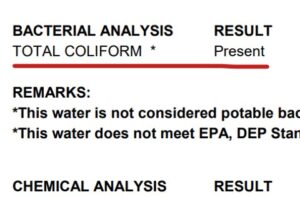
It’s one of the most common questions we get after a water test, so here’s what a positive result usually means, why it happens more often than it used to, and what to do next.
The usual culprit: your faucet, not your well
When bacteria show up in a water sample, they come from one of two places: the faucet the sample was drawn from, or the well itself. In our experience, it’s almost always the faucet.
Think about how a kitchen faucet gets used. You handle raw chicken, then rinse your hands under the tap. Water splashes up onto the spout and into the aerator, the small screen at the tip of the faucet. That aerator stays damp, warm, and sheltered, which makes it an ideal place for bacteria to settle in and grow. Bathroom faucets aren’t far behind.
Contamination inside the well is a different story. It’s uncommon in typical residential settings and more likely on farms or rural properties where animal waste can reach the groundwater. Out of thousands of water tests, we’ve found exactly one contaminated well, and in that case street runoff was draining directly into it.
Why more tests come back positive than they used to
If you had a well tested ten years ago and it came back clean, you might wonder why the results look different now. The answer is a change in how samples are collected.
We follow EPA sampling protocols. Until about 2017, those protocols called for removing the faucet aerator and sterilizing the inside of the faucet with a flame before taking the sample. That step killed any bacteria living at the faucet, so tests almost always came back negative.
The EPA has since revised the protocol. Today the faucet is sampled as-is, after the water has run for a few minutes, which is how people actually draw water to drink. As you’d expect, positive results went up after the change. About 20% of the tests we run now come back positive for coliform.
One important limitation: the lab can tell you that bacteria are present, but not where they came from. That’s where experience comes in, and our experience points strongly to the faucet.
What to do about it
The fix is usually simple:
- Replace the faucet aerator, or the whole faucet. Aerators are inexpensive and available at any hardware store. You can also clean the faucet and aerator with a bleach solution, but replacement almost always resolves the problem.
- Retest. Take the new sample from the cleaned or replaced faucet, or from a fixture people rarely touch, such as the washing machine hookup.
If the retest still comes back positive, the well may be the source. In that case, the well can be disinfected by shock chlorination, typically using unscented household bleach. A water treatment professional can confirm the cause and handle the process for you. Wait to retest until the chlorine has fully flushed out of the system, because the lab cannot accept samples with detectable chlorine.
When it’s E. coli
Most positive results are for total coliform, a broad group of bacteria that is common in the environment. If your report shows E. coli specifically, take it more seriously. E. coli comes from human or animal waste and can cause illness.
Until the problem is resolved and a retest comes back negative, don’t drink the water or use it for cooking, brushing teeth, or making ice unless you boil it first (a full rolling boil for at least one minute). Bottled water is an easy alternative. Contact a water treatment professional promptly to find the source and disinfect the system.
The bottom line
A positive coliform result is worth acting on, but it’s rarely cause for alarm. In most cases, a new faucet aerator and a retest are all it takes.
Chester County Home Inspections provides water quality testing throughout Chester County and the surrounding counties. We collect samples using EPA protocols and deliver them to a PA-DEP certified laboratory. If you have questions about your results, or need a retest, get in touch.
Findings Explained, Not Just Flagged.
Chester County Home Inspections, LLC