
If you’ve spent any time house hunting in this area, you’ve probably come across homes being reskinned like this due to “bad stucco”. The reputation is earned, but applied indiscriminately to any home with stucco. Learn about good and bad stucco, and how we inspect it.
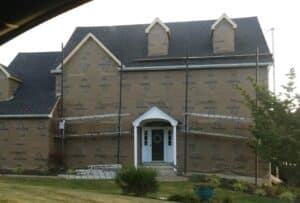
It’s not the age of the house that matters. It’s the decade it was stuccoed.
Homes built in the 1980s and earlier were typically finished with traditional three-coat portland cement stucco, installed without the shortcuts that came later. We rarely find significant stucco issues on houses from that era.
The mid-1990s through the mid-2000s is a different story — and the cause isn’t what most people assume. You’ll often hear synthetic stucco, or EIFS, is blamed for the region’s stucco reputation. The real problem in this region is conventional, hard-coat stucco that was installed poorly during that building boom, and it usually comes down to three shortcuts:
1. Applied too thin. Traditional three-coat stucco — scratch coat, brown coat, and finishing coat — is build up to a solid overall thickness of 3/4″ or more. In homes from this era, it’s routinely found barely 3/8″ thick.
2. No drainage. Thin stucco cracks more easily, so installers often set it flush against the sheathing to borrow the sheathing’s rigidity as backbone support — a shortcut that also eliminates the drainage gap that would let any moisture behind the cladding escape. Even the better jobs, which used a wire mesh standoff to create a real gap, were still typically applied thin. And almost none of it — flush or standoff — included a weep opening at the base of the wall, so there was rarely anywhere for water to drain out even where a gap existed.
3. Inadequate flashing. Missing or undersized flashing above windows and doors gave water a way into the wall assembly in the first place.
Any one of these on its own is a problem. In practice, we often find all three stacked together on the same house. Homes built in this window get the closest look during our inspection.
What we actually check for
On every stucco exterior, we look for:
– Visible signs of water penetration behind the stucco — most commonly streaking below windows or staining at the lower sides of doors, which point to water tracking down from a failure point above.
– Areas where we can determine the stucco’s actual thickness, since undersized application is such a common contributor to moisture problems in this region.
– Adequate flashing above doors and windows — one of the most important, and most frequently missed, details in a properly installed stucco system.
– Presence of weeps — if none found, a drainage plane is likely missing.
Two popular tools we deliberately don’t use
You may have heard of home inspectors using moisture meters or infrared cameras on stucco. We don’t use either, and here’s why:
Moisture meter probe testing relies on the idea that water sitting behind the stucco will register on a probe. A probe test done even a few days after rain will often come back positive whether or not there’s an active problem — which makes the results unreliable and prone to false alarms.
Thermography (infrared imaging) shows temperature variance, not moisture content. Since temperature differences don’t necessarily line up with the presence of water, it can flag a problem that isn’t there, or miss one that is.
Both tools have legitimate uses elsewhere in construction diagnostics, but neither gives buyers or sellers a trustworthy answer about what’s actually happening behind a stucco wall.
When further testing is warranted
If what we observe during the inspection suggests moisture may be present behind the stucco, we recommend an invasive, or core, stucco inspection — performed by a specialized trade, not by us. We keep a short list of vendors we trust and we’re happy to pass along a recommendation.
We’re upfront with clients that this kind of testing is expensive, and it’s completely understandable that many homeowners don’t want their stucco cored just to find out. That’s a reasonable position. But in a real estate transaction, it’s worth knowing that a seller who refuses to allow a core test may be trying to avoid confirming a problem they’re already aware of. That’s not proof of a hidden issue — but it’s a data point worth weighing.
Stucco isn’t automatically a red flag, and a house built in the “bad stucco” window isn’t automatically a bad house. It just means the details matter more, and it’s worth having someone look closely at the right things instead of relying on tools that only look reliable.
Findings Explained, Not Just Flagged.
Chester County Home Inspections, LLC